-
Jordan Mitchell
- No Comments
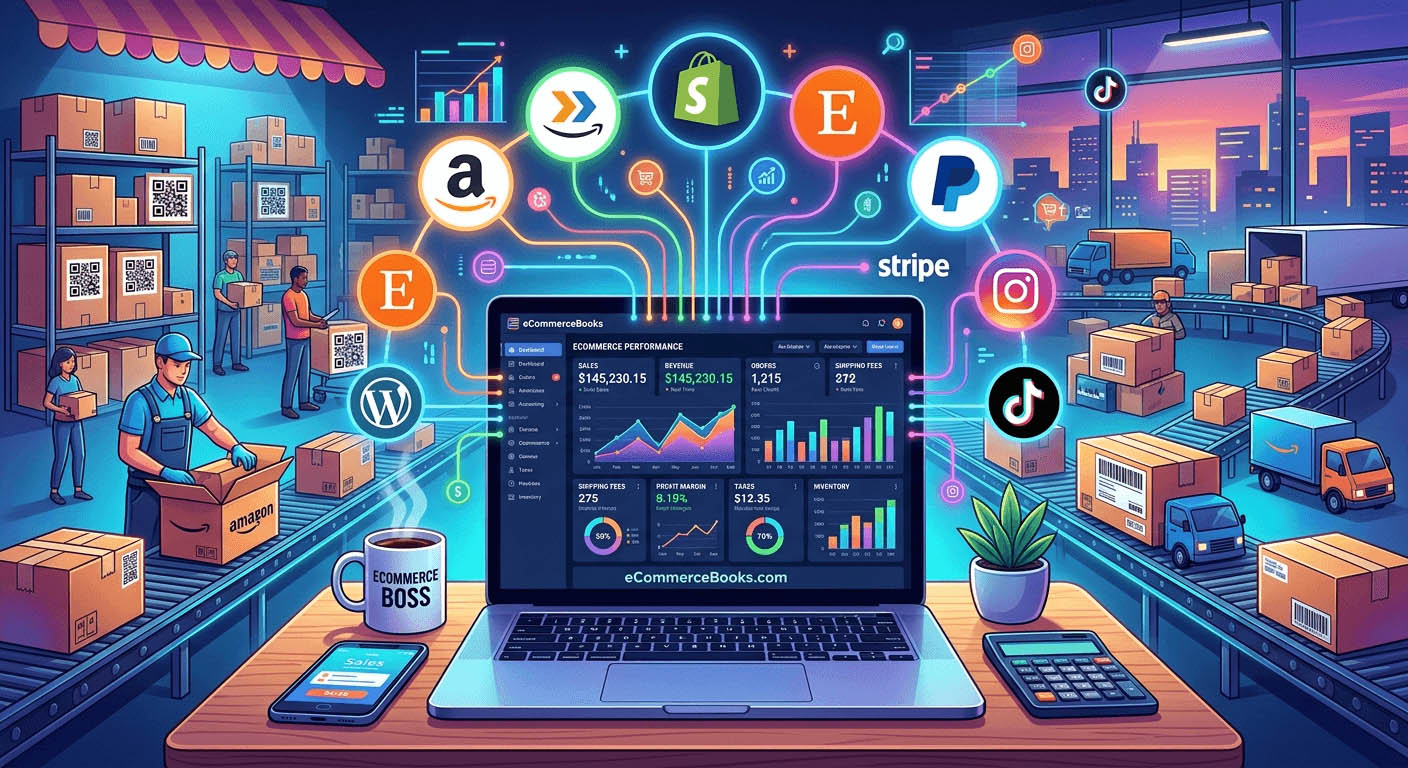
Running an online store in 2026 is nothing like running a traditional retail shop. You might be selling across Shopify, Amazon, TikTok Shop, and your own website all at once. Each platform pays on different schedules, charges different fees, and reports revenue in its own format. Most accounting tools were designed before any of this existed. They assume one bank account, one currency, and one sales channel. That mismatch creates real problems for online sellers, and it only gets worse as you grow.
The Core Problem for Online Sellers
Generic accounting software was not built for multi-channel commerce. Online businesses need tools that handle platform fees, multi-currency payouts, refunds, and digital product margins automatically. Using the wrong software means hours of manual reconciliation every month and a growing risk of costly errors at tax time.
The Spreadsheet Trap That Catches Growing Brands
Most founders start with spreadsheets. That is a perfectly reasonable choice when you have one product and one channel. But the moment you add a second platform or a third supplier, those spreadsheets become a liability.
The problems compound fast:
- Payouts from Shopify, Amazon, and PayPal all land on different days with different fee structures deducted
- Refunds and chargebacks show up weeks after the original sale, making monthly closes painful
- Sales tax across different regions requires a level of detail that spreadsheets simply cannot track cleanly
- Inventory costs and cost of goods sold (COGS) calculations become manual nightmares
- There is no audit trail, no access controls, and no version history
At some point, spreadsheets stop saving time and start costing it. That is the moment most online brands start shopping for real accounting software.
Reconciling Multi-Channel Revenue Without Losing Your Mind
This is where the real gap between generic accounting software and purpose-built tools becomes obvious. A platform like Xero or QuickBooks will show you a bank deposit from Shopify. But it will not automatically break that deposit into gross sales, platform fees, refunds, and net payout. You have to do that yourself, every single time.
Proper e-Commerce accounting tools are designed around this exact workflow. They connect directly to your sales platforms and payment processors. They understand that a Stripe payout is not the same as a Stripe sale. They separate gross revenue from fees so your profit and loss statement actually reflects reality instead of just what landed in your bank account.
This matters enormously for decisions you make every day. If your COGS and platform fees are not properly separated, your gross margin numbers are wrong. And if your margins are wrong, your pricing decisions, ad spend targets, and supplier negotiations are all built on a shaky foundation.
What Sets Ecommerce Accounting Apart From Generic Tools
Not all cloud accounting software is created equal. Generic platforms handle invoices and bank feeds. Ecommerce-focused tools go further. Here is what separates them:
- Automatic fee separation: Platform fees, transaction fees, and fulfilment costs are pulled out of gross revenue automatically, not lumped into a single deposit figure.
- Inventory-aware reporting: COGS is calculated based on what actually sold, not just what you purchased. This is critical for accurate margin tracking.
- Refund and chargeback handling: Returns are matched back to original orders, not treated as standalone negative transactions.
- Multi-currency support: If you sell in USD, GBP, AUD, or HKD across different markets, your software needs to handle FX conversions cleanly.
- Sales tax and VAT compliance: Especially important if you sell across borders or into multiple US states.
- Real-time cash flow visibility: Knowing what money is actually available versus what is pending settlement changes how you manage stock orders and ad budgets.
These are not nice-to-haves. For a DTC brand doing any meaningful volume, they are the baseline.
Comparing Cloud Accounting Options for Online Businesses
The cloud accounting market has matured significantly. Xero and QuickBooks remain the two most recognized names globally. But neither was designed with the ecommerce operator in mind. Their workflows assume a services or traditional retail model. Customizing them for multi-channel online sales often requires third-party apps, manual rules, and workarounds that pile up over time.
Many online business owners who started with Xero eventually start researching Xero alternatives once they hit growth inflection points. The reasons vary. Pricing becomes harder to justify as team size grows. The ecommerce integrations feel bolted on rather than native. Support for marketplace-specific fee structures is limited. And the reporting, while solid, does not always give online sellers the channel-level breakdown they need to make fast decisions.
The good news is there are purpose-built alternatives that price more fairly for small and mid-sized online businesses, connect directly to the platforms you actually use, and do not require an accountant to interpret the dashboards.
Key Factors to Evaluate When Choosing Accounting Software
Before committing to any platform, check these criteria against your actual business model:
- Does it connect natively to your sales channels without a paid middleware app?
- Can it handle inventory COGS calculations automatically?
- Does pricing scale reasonably as your transaction volume grows?
- Are the reports readable by a non-accountant?
- Does it support multi-currency if you sell internationally?
- Is there a clear audit trail for every transaction?
Financial Reporting That Actually Informs Decisions
One of the biggest gaps in most ecommerce setups is reporting. Sellers often know their top-line revenue number but have very little visibility into what is actually driving profitability. Is that new product line actually margin-positive after platform fees? Is one channel dragging overall performance down?
Good financial reporting for an online business should answer these questions without requiring you to export CSVs and build pivot tables. Channel-level P&L, product-level margins, and period-over-period comparisons should all be accessible in a few clicks.
This kind of visibility changes how you run the business. You stop making decisions based on gut feel or last month’s bank balance. You start making decisions based on actual contribution margins and category-level performance. That shift is often what separates brands that scale from brands that plateau.
Managing Expenses, Bills, and Cash Flow as You Scale
Revenue management is only half the picture. On the cost side, online businesses have a distinct set of challenges too. Ad spend fluctuates week to week. Supplier invoices come in batches. Subscription tools stack up quietly in the background. Shipping costs vary by carrier, zone, and product weight.
Keeping all of this organized requires more than a filing system. You need software that tracks every outgoing dollar, matches it to the right cost category, and flags when something looks off. Keeping expense tracking tight is especially important for founders who are still handling their own finances without a dedicated bookkeeper.
Cash flow is the other critical variable. A business can be profitable on paper and still run into cash problems if payouts are delayed, supplier payments cluster together, or a large refund hits unexpectedly. Monitoring cash flow management in real time, not just at month end, gives you the runway to make better decisions about when to restock, when to run a promotion, and when to pull back on spend.
Building a Finance Stack That Grows With Your Team
At some point, most online businesses stop being solo operations. You hire a customer service rep, bring on a logistics coordinator, or add a part-time finance person. That is when the accounting setup you built as a solo founder starts to crack.
Sharing a single login is a security risk. Having no expense approval workflow means money leaves the business without oversight. Paying someone back for a business purchase from your personal bank account every few weeks is not a sustainable system.
This is exactly where team finances functionality becomes essential. You need role-based access so your logistics person can view shipping costs without seeing your full P&L. You need an expense claims workflow so staff can submit receipts and get reimbursed without emailing spreadsheets. You need payroll visibility that connects to your overall cash position so you always know what payroll week looks like before it hits.
Getting this infrastructure right early saves a significant amount of pain later. Finance teams that are brought into a clean system from day one spend far less time cleaning up data and far more time generating insights.
The Right Tool Pays for Itself
Accounting software is not an overhead cost for an online business. It is infrastructure. The hours saved on manual reconciliation, the tax errors avoided, the margin decisions made with real data instead of guesswork, and the ability to onboard a finance hire into a clean system rather than a mess of spreadsheets all add up to real money.
Online sellers who treat their accounting setup as an afterthought tend to hit the same walls at the same growth stages. The brands that build clean financial foundations early move faster, raise more confidently, and scale without the rework.
If your current tools were not built for ecommerce, the cost of switching is far lower than the cost of staying.

No Comments