-
Jordan Mitchell
- No Comments
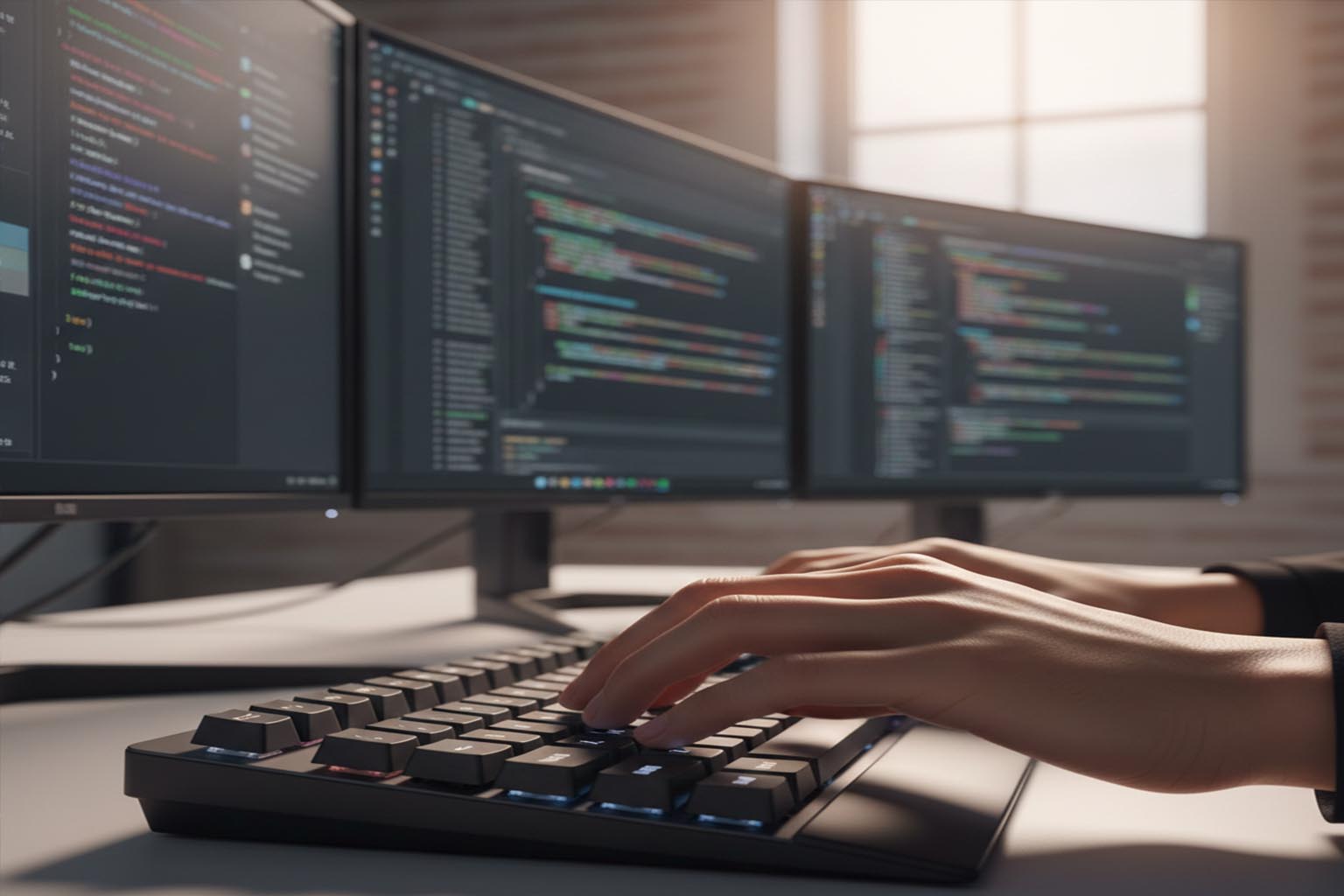
Speed on a keyboard might look trivial at first glance. It is not. In knowledge based economies, input speed shapes output volume. Every email, report, code commit, support reply, and policy draft begins with keystrokes. Typing speed is not about bragging rights. It is about throughput. It reflects how efficiently a worker can translate thought into digital action.
Digital literacy is often framed around software knowledge, cybersecurity awareness, or AI fluency. Those matter. Yet the basic mechanical skill of typing is rarely discussed as a measurable economic input. A simple online typing test offers more than a game score. It provides a quantifiable signal of readiness for digital work, remote collaboration, and AI assisted workflows.
Article Snapshot
- Typing speed is a measurable productivity input in digital economies.
- Keyboard proficiency affects output, focus, and cognitive load.
- Benchmarking tools provide workforce readiness signals.
- Organizations can use typing metrics for training and upskilling.
- Input efficiency supports AI collaboration and automation gains.
From Basic Skill to Economic Signal
Digital economies run on information exchange. That exchange depends on input devices. While voice tools and automation are growing, keyboards remain dominant across offices, classrooms, and remote setups. A worker who types 40 words per minute produces half the raw text of someone who types 80 words per minute in the same time window. The gap compounds over weeks and months.
This framing aligns with broader conversations about measuring digital transformation impact. Transformation is not abstract. It is reflected in operational metrics. Time to complete documentation. Speed of internal communication. Responsiveness to clients. Typing speed becomes one of the simplest measurable inputs that influence those outputs.
In high velocity environments, small inefficiencies scale. Ten extra minutes per day spent correcting typing errors equals over forty hours per year. That is a full work week lost to friction. As firms refine digital strategy, keyboard proficiency deserves recognition as a baseline capability, not an afterthought.
Input Efficiency in AI Driven Workflows
Artificial intelligence has altered digital work. Generative systems draft text, summarize reports, and suggest code. Yet the human role remains central. Prompts must be crafted. Edits must be made. Context must be clarified. Faster typing allows faster iteration. It reduces the pause between thought and refinement.
Research in human computer interaction consistently finds that fluent keyboard use reduces cognitive load, a concept defined in cognitive load theory as the total mental effort required to perform a task. When typing becomes automatic, working memory is freed for analysis, synthesis, and decision making. Slow, hesitant input consumes that limited capacity. Attention shifts from ideas to mechanics, and the depth of reasoning often suffers as a result.
This connection becomes sharper in AI assisted tasks. Prompt engineering often requires multiple refinements. Professionals who can rapidly test variations gain speed advantages. They run more experiments in less time. They refine outputs with greater precision. Input speed becomes a force multiplier for AI productivity.
How Typing Speed Reflects Digital Literacy
Digital literacy involves more than opening apps. It includes the ability to operate efficiently within digital systems. Typing speed is one proxy for that operational fluency. It signals comfort with interfaces, familiarity with shortcuts, and the habit of structured digital communication.
Consider how typing proficiency intersects with digital tools boosting efficiency. Project management platforms, CRM dashboards, analytics tools, and collaborative documents all require rapid input. Workers who struggle with basic typing often avoid deeper engagement with these systems. That avoidance can limit adoption and stall productivity gains.
Typing speed alone does not define literacy. Accuracy matters. Structure matters. Security awareness matters. Yet as a measurable metric, words per minute combined with accuracy percentage provides a quick baseline assessment. It is simple. It is accessible. It is scalable across teams and regions.
Quantifying the Impact on Productivity
The economic implications of typing speed can be illustrated with simple math. Assume an analyst writes 1500 words per day across emails, reports, and internal notes. At 50 words per minute, that requires 30 minutes of pure typing time. At 80 words per minute, it takes under 19 minutes. The difference is 11 minutes daily.
Multiply 11 minutes by 220 working days. That equals 2420 minutes per year. Divide by 60. Over 40 hours are recovered. That reclaimed time can be redirected to analysis, client engagement, or skill development. These calculations show how a micro skill shapes macro outcomes.
| Typing Speed | Daily Typing Time | Annual Time Used | Time Recovered vs 50 WPM |
|---|---|---|---|
| 50 WPM | 30 minutes | 110 hours | Baseline |
| 65 WPM | 23 minutes | 84 hours | 26 hours saved |
| 80 WPM | 19 minutes | 70 hours | 40 hours saved |
The table above simplifies reality. It does not account for editing time, research pauses, or meetings. Yet it captures direction. Faster input compresses routine tasks. Over time, that compression accumulates into measurable capacity gains.
Four Practical Benchmarks for Workforce Readiness
Organizations can treat typing speed as an operational benchmark. It should not be punitive. It should be developmental. Below are four practical reference points that can guide internal assessments.
1. Under 40 WPM, foundational training recommended. Productivity constraints are likely in text heavy roles.
2. 40 to 60 WPM, functional level. Suitable for general office roles with moderate writing volume.
3. 60 to 80 WPM, strong proficiency. Supports high output communication and AI collaboration.
4. 80 WPM and above, advanced fluency. Enables rapid drafting, editing, and iterative workflows.
These ranges are not rigid. Industry context matters. A software engineer may require less daily prose than a policy analyst. A customer support agent may need high speed and high accuracy simultaneously. The key insight is that typing speed can be measured objectively and improved systematically.
Accuracy, Focus, and Cognitive Flow
Speed without accuracy creates rework. Rework erodes productivity gains. A digital literacy metric should combine words per minute with error rate. Many assessment platforms already report both figures. Tracking improvement over time encourages deliberate practice.
There is also a psychological dimension. Fluent typing reduces friction. Reduced friction sustains focus. Sustained focus improves reasoning depth. In complex digital tasks such as financial modeling, cybersecurity documentation, or AI system configuration, uninterrupted cognitive flow is valuable.
- Fewer typos reduce correction cycles.
- Automatic finger movement lowers mental strain.
- Consistent rhythm supports structured thinking.
- Higher confidence improves digital engagement.
Each of these factors feeds into overall digital competence. They influence how confidently professionals interact with dashboards, code editors, communication tools, and documentation platforms.
Education Systems and Early Benchmarking
Schools often emphasize coding and device usage. Typing instruction is sometimes compressed into brief modules. Yet early keyboard training may yield long term economic dividends. Students who master touch typing in primary or secondary school carry that efficiency into higher education and the workforce.
Routine benchmarking using accessible testing platforms can help educators track progress. Students gain immediate feedback. Teachers gain measurable data. The process normalizes skill improvement rather than treating typing as a trivial add on.
In economies investing heavily in digital infrastructure, foundational input skills should not be overlooked. Digital inclusion requires more than access to devices. It requires the capacity to use those devices efficiently and confidently.
Corporate Training and Upskilling Strategy
Corporate learning programs often prioritize leadership, analytics, and compliance. Keyboard proficiency rarely appears in training catalogs. That omission may be costly. Offering optional typing workshops or gamified improvement programs can yield measurable returns at low cost.
Training programs can integrate periodic assessments, targeted drills, and ergonomic education. Ergonomics matters because discomfort slows performance and increases error rates. Small investments in keyboards, posture awareness, and structured practice can improve both speed and wellbeing.
Data from internal assessments can also inform workforce planning. Teams with slower average typing speeds may require workflow redesign or additional automation support. Teams with high fluency may adapt faster to AI augmented processes.
Typing Speed in Remote and Global Work
Remote work amplifies the importance of written communication. Chat platforms, collaborative documents, and asynchronous updates replace many verbal interactions. In global teams across time zones, written clarity becomes the backbone of coordination.
Professionals who type quickly can respond faster, clarify misunderstandings sooner, and keep projects moving. That responsiveness influences client perception and team cohesion. In distributed environments, the keyboard is the primary channel of presence.
As digital summits, virtual conferences, and online marketplaces expand, the ability to generate structured written content rapidly becomes part of economic participation. Typing speed is not glamorous. It is foundational.
A Metric Worth Measuring
Digital literacy metrics often focus on advanced competencies. Those deserve attention. Yet input efficiency is measurable, improvable, and economically relevant. Words per minute and accuracy percentage provide a clear baseline. Improvement can be tracked over weeks. Gains translate into reclaimed time.
In knowledge economies driven by information flow and AI augmentation, every saved minute compounds. Typing speed is not the sole determinant of success. It is one input among many. But it is one of the few that can be tested quickly, improved deliberately, and linked directly to daily productivity.
As policymakers, educators, and business leaders refine digital capability frameworks, keyboard proficiency deserves inclusion. It reflects readiness. It signals comfort with digital systems. It supports deeper engagement with advanced tools. Measured carefully, it becomes more than a skill. It becomes an economic indicator.


No Comments